

The 9th generation slalom race foil sail from Severne: the Hyper 9. For the past 2 years, we’ve been foiling with the Hyper 7, and we have now switched to the Hyper 9. Even though the biggest developments in race foiling seem to have leveled off, the Hyper 9 doesn’t just look different; it feels very different too. Below you can read our detailed findings.
Trend towards a flatter profile and better low-end performance
Slalom foiling has developed significantly in recent years. In the PWA, average racing speeds are well over 50 km/h, with top speeds exceeding 60 km/h. Furthermore, modern foils have smaller wings and less drag than before, meaning riders no longer need the ‘brute power’ in the sail that they used to.
More emphasis on high-end performance
This means sail design and aerodynamics must be approached differently. Drag and ‘apparent wind’ play an increasingly important role in sail design. A sail must also ensure you get onto the foil quickly (with small wings) and that drag is minimized at high speeds.
28.8 knots of apparent wind in just 10 knots of wind!
Try slalom windfoiling in 10 knots of wind (= 18.5 km/h) with an 8.0 m2. It is perfectly possible to achieve speeds of over 50 km/h (27 kn).
This means the apparent wind speed is a whopping 53.3 km/u (28.8 kn)! Where the airflow (apparent wind) ‘blows’ into the sail almost entirely from the front/luff (at an angle of 20 degrees). So you create your own wind and your ‘own power’ in your sail.
With 10 knots of true wind, the challenge isn’t creating enough power, but ensuring the most effective airflow along the sail, allowing the sail to easily bleed off excess pressure.

A flatter profile is one aspect of the latest generation of windfoil slalom sails, but reducing the surface area also helps reduce drag.
By increasing a sail’s low-end performance, you can foil sooner with a smaller size. And a smaller sail means noticeably less drag and therefore more speed. You also see this principle in the America’s Cup and Sail GP, where speeds are much higher than in windfoiling.
First impressions of the Hyper 9
The Hyper 9 still has 7 battens and 4 cambers. Only the 4.0 and 5.0 meter versions have just 6 battens. But during rigging, it immediately becomes clear that the profile of the Hyper 9 is much flatter. Where the sail almost touched the boom on the Hyper 7, the distance is now around 3 to 4 centimeters. The top of the sail has become narrower, while the foot has become much wider.
At first glance, the twist (loose leech) in the sail seems comparable to previous generations. However, when you look at the sail from the front, the mast (also) bends much more to leeward. Both above and below the boom. The foot of the sail also blows out quite quickly (more on this below). The profile of the sail looks a bit strange on the beach. It’s as if a mast with the wrong curve was used. Ed. note: we use the APEX team masts in the Hyper 9 and the RDM Red for the 5.0m2.
On land, the sail feels light in the top, but at the same time, we feel a lot of power. The rotation of the sail is similar to the Hyper 7, although we have the impression that (due to the flat profile) the cambers need more pressure in the sail to flip smoothly.
Hyper 9 = Powerrrrrr
We hit the water first with the 8.0m2. We’re using our favorite board, the FMX Hyperion 158, with the Patrik AEON foil. What immediately stands out when pumping is how ‘soft’ the sail feels. But soft in a positive way. We feel that every pump stroke is very effective and is directly converted into speed. The older generations felt a bit ‘stiffer’ and ‘deader’. Because of this flex in the sail, we get onto the foil very easily and quickly. Clearly faster than with the Hyper 7 8.0m2. With about 9 knots of wind and a 550 cm2 front wing, we get onto the foil just fine!
Once on the foil, the sail feels very ‘slippery’. The GPS also clearly shows that we easily go faster than with the old sails. If you bear away in a gust, we experience acceleration like we’ve never felt before. By simply keeping the sail closed (see the paragraph on apparent wind), we keep the wind at the right angle relative to the apparent wind downwind (with only 10 to 12 knots of wind), which maintains really good pressure for great acceleration. A new experience for us.
Based on experience with previous generations of Hypers, we tended to trim the leech a bit looser in less wind using the outhaul trim system. We initially did this with the Hyper 9 as well. But strangely enough, the feeling of power remains the same with slightly more outhaul tension, but you immediately feel the profile becoming even more efficient. It feels like we’re on the board with a ‘weirdly flat sail’, but in fact, this (more easily) results in a higher average speed. And a higher average speed means a higher apparent wind speed = more power in the sail.
Once used to the flat setting, we notice how easy and light the Hyper 9 feels, even though the sail actually always feels ‘full power’. At around 85 kg, it’s not very effective to keep foiling for too long in the upper wind range of the size. We notice that we have to switch to a smaller size about 2 to 3 knots earlier compared to the Hyper 7. And at the same time, we experience that we can foil ‘well powered up’ with about 4 to 5 knots less wind compared to the Hyper 7.
Ultra stable
We’ve written about it before. It seems like the average wind in the Netherlands is becoming increasingly gusty. That generally makes high-speed slalom windfoiling quite challenging. The more forgiving a sail handles gusts (by passing less downforce to the board), the easier it is to stay stable and keep pushing in gusty conditions.
The Hyper 9 feels very stable in every respect and is also clearly less sensitive to gusts in the sail. Partly due to the flat profile of the sail, the amount of downforce it generates is noticeably less. As a result, the nose of the board is pushed down significantly less during gusts. We’ve found that we have many more enjoyable slalom foil days than before. Entirely thanks to the stable profile of the Hyper 9. This allows us to stay in our ‘optimal stance’ much more, so we can keep focusing on pushing. A fine and rewarding characteristic of this sail.
Many tuning options
Severne seems to have mastered the art of maximizing tuning possibilities. The sail has no fewer than 4 outhaul eyelets!
The principle is as follows:
When using the inner eyelets, the sail can bleed off power a bit more easily. And the lower the boom is (bottom eyelets), the more control you have;
- The outer eyelets (1 and 3) provide more power
- The inner eyelets (2 and 4) give the sail a softer feel and less power
- The upper eyelets (1 and 2) give a bit less control
- The lower eyelets (3 and 4) give the rider more control

Our favorite setup
Naturally, we tested all 4 settings. Our preference is position 2. Even in light wind, we still have enough power, and the sail bleeds off pressure a bit more easily, making it feel lighter and making us faster.
The bottom two, and specifically position 4, was our preference in ‘survival mode’. We noticed that at the limit, we could control the sail for just a few knots longer. In summary, in 90% of cases, we use setting 2 for all sizes.
The smaller the size, the more impressive the acceleration
In addition to the 8.0m2, we’ve now had several sessions with the 7.0m2 and the 6.0m2. What stands out positively is that the feel across the different sizes is very consistent. Often, one size feels just a bit different from the size above or below it. These 3 sizes really feel the same, with the 8.0m2 being relatively better in the low end and the 6.0m2 more in the high end. We haven’t experienced a range giving such a consistent feel as this series before.
What is a big difference, however, is the degree of acceleration between the different sizes. The smaller the size, the more impressive the acceleration as soon as we bear away. This clearly has everything to do with the drag, which is significantly less with a smaller size. We haven’t experienced these differences in ‘drag’ so clearly before.
Purpose of the ‘tack strap’ on the foot
Like most sails, the Hyper 9 has a so-called ‘tack strap’ at the downhaul to tension the foot. Normally, this creates a slightly ‘deeper belly’ in the sail for more power. Usually, you can wrap that strap neatly around the bottom of the mast extension and tighten it.
On the Hyper 9, that strap is about 4 cm lower, making it too low to wrap around the mast extension. If you try anyway, a strange crease forms in the foot near the mast. We checked with Severne to see what the reasoning behind this is. Severne indicates that for the Hyper 9, this strap should actually not be tightened.

By NOT tightening the strap, the foot can easily spill wind to bleed off the airflow as efficiently as possible. So, that strap on the Hyper 9 is a bit of a strange and unclear ‘thing’. What we do is wrap the strap very loosely around the bottom of the mast extension and don’t tighten it.
Easy high-end sail
As described, slalom windfoiling is becoming increasingly high-end. Equipment is being increasingly tuned to today’s extreme slalom foils.
We see that reflected in the shape of the Hyper 9. It’s all the more striking to notice that the sail feels very easy and friendly during windfoiling. More than previous generations, this is a top-tier high-end sail. But it’s also more than ever an easy and accessible sail for NON-PWA riders.
If you have questions or want to know more about tuning the Hyper 9. Feel free to let us know.
-
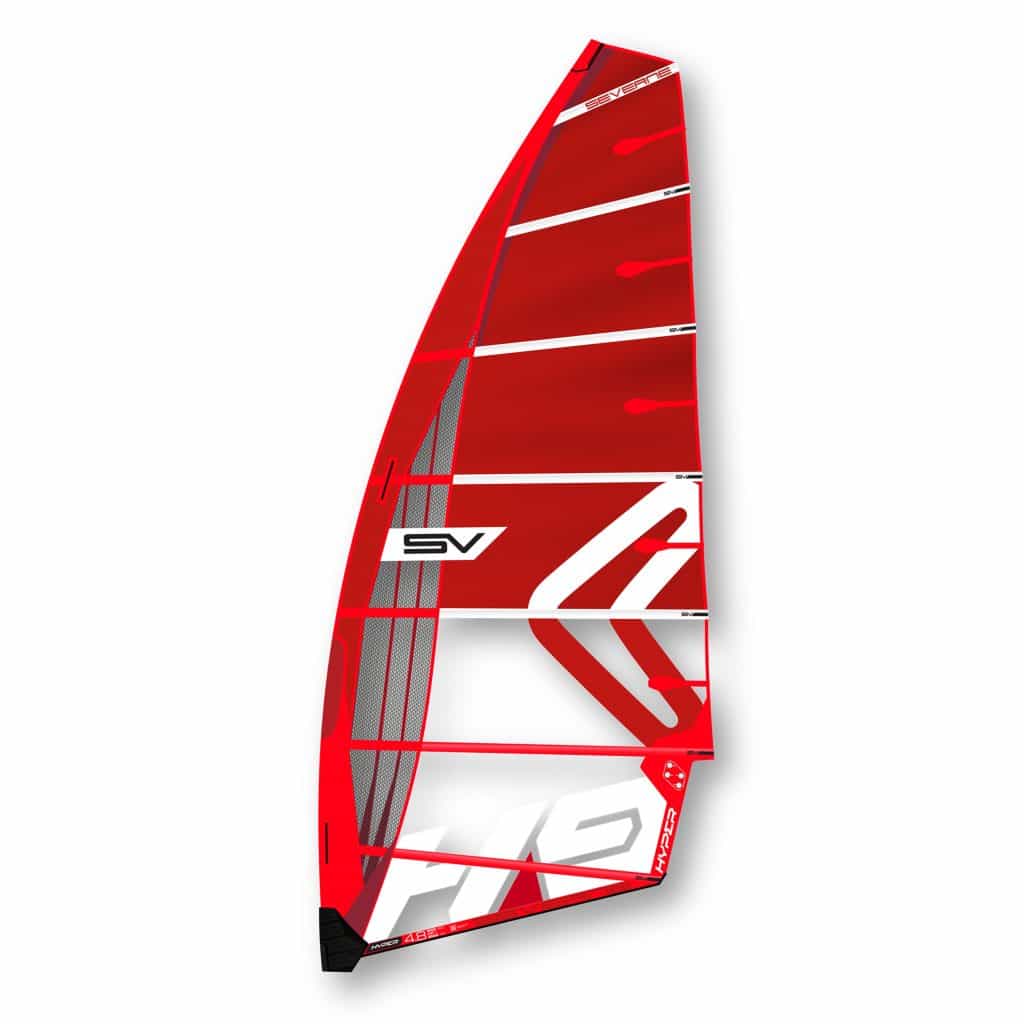
Severne Hyper 9 foil slalom
Price range: €1.259,00 through €1.559,00 incl. VAT
