


We had been waiting for a new freeride/freerace foil sail from Severne for some time. The FoilGlide 3 was sold out, and we had to rely on the Severne FGO (Iqfoil youth sails), which is essentially the FoilGlide 2. But now it’s finally here: the Severne HyperLite. According to Severne, this sail should feel and perform closer to a race sail. It’s high time to test the 6.6 m² on the water and compare it with the Severne Hyper 7 7.0 m² and the Severne FGO 7.0 m².
Available sizes of the HyperLite
The Severne HyperLite is available in four sizes: 4.4 m², 5.5 m², 6.6 m², and the largest, 7.7 m². The smallest size fits a 370 cm RDM mast, the 5.5 m² requires a recommended RDM 400 cm mast, and the two largest sizes are both suitable for the RDM 460 cm mast.
All four sails are equipped with three cambers. The two smallest sizes have five battens, while the two largest sizes feature six battens.


More downhaul tension and an open leech
When rigging, it quickly becomes clear that the HyperLite has a very different shape than the FoilGlide / FGO. The sail clearly has much more downhaul tension, which also makes the leech much more open. Additionally, the mast feels less soft due to the higher downhaul tension. Furthermore, it is noticeable that the bottom two cambers are placed below the boom, visibly creating a deeper profile below the boom. All these elements are also seen in high-end (Hyper) race sails.
Once the sail is properly rigged, we fortunately notice that the rotation of the cambers is as smooth as with the Foil Glide / FGO sails. This ensures that jibing and tacking go smoothly.
Reduced back hand pressure
Then onto the water. We opt for a freerace/slalom setup with the Starboard SLX slalom foil and the Starboard Freeride. The wind is initially quite light, around 9 to 13 knots. We have to pump hard to get on the foil. What immediately stands out is that, despite the higher downhaul tension and the open leech, the sail still pumps effectively. As a result, we still easily get onto the foil. The 6.6 m² has slightly less ‘low end’ performance than the FGO 7.0 m², but the difference is minimal.
Once on the foil, the HyperLite feels very light and stable. Especially on the reaching course, this sail feels much lighter and more comfortable. With increasing wind, you often experience a lot of back hand pressure with the Foil Glide / FGO, causing the sail to become unbalanced and making it difficult to stand relaxed on your board. This is not the case with the HyperLite. This sail is clearly optimized for reaching course / downwind courses. The harder the wind, the greater this difference becomes.
Comparing the HyperLite 6.6 m² with the Hyper 7 7.0 m², the low wind performance of the HyperLite is better. The sail pumps more effectively than the Hyper, and we get onto the foil faster and more easily than with the Hyper 7.0 m². In medium conditions, the feel of the HyperLite is quite comparable to the Hyper 7. However, when the wind increases to overpowered conditions, the Hyper remains stable longer than the HyperLite. The Hyper 7 also clearly has better acceleration and top speed. On average, the Hyper feels heavier than the HyperLite.
Less good upwind
As mentioned earlier, this sail is optimized for reaching course, just like the Hyper sails. Partly due to the open leech, the upwind performance of the HyperLite is less than that of the FoilGlide / FGO. For optimal upwind foiling, a sail with a ‘tighter’ leech and a bit more back hand pressure is desired.
High-end performance of the HyperLite
In ‘full power’ conditions, the HyperLite is also much faster than the FoilGlide, but the sail lacks the acceleration and ‘drive’ of a full camber race sail. For that, the stability and pure power of this sail are insufficient. The Hyper, on the other hand, can be ‘overwhelming’ for some riders due to its enormous power. The HyperLite thus offers an excellent mix in between.
Tuning the HyperLite
We adhered to the recommended settings for the 6.6 m². If we fully tighten the downhaul (‘on the block’ of the extension), we have the maximum open leech. By loosening the downhaul about 1 to 1.5 cm, we create a very fine low wind setup.
Severne standardly supplies extra spacers with the camber sails to increase the distance of the cambers. Although this is often something for the pros, we noticed a clear difference.
- With the standard spacer (which is always on), we missed some ‘drive’ in the sail. The handling was optimal, and we had a ‘freeride feel’. A fine setup for ‘easy freeriding’.
- With an extra (thin) spacer on the bottom two cambers, the profile became slightly deeper and fixed. The rotation decreased marginally, but we clearly felt more ‘drive’ in the sail. This made the sail measurably about 4 to 5 km/h faster.
HyperLite clearly more Freerace
We have now done 8 to 10 sessions with the HyperLite in light wind, and we have also pushed the sail in over 20 knots of wind. We can only say that the HyperLite is a very fine sail with a wide range of use and clear ‘race genes’.
Of course, the absolute performance is not comparable to the Hyper, but in terms of shape, feel, and performance, the sail has made a significant step towards race. In our opinion, rightfully a ‘freerace windfoil sail’.
If you just want to enjoy freeriding with the sail, the standard setup is fine. If you want to get the maximum race performance out of the sail, we recommend placing an extra spacer on the bottom two cambers. That clearly delivers measurably better performance.
If you find good upwind performance important, the Severne FGO (the Foil Glide 2 or 3 is no longer available) is a better option.
-
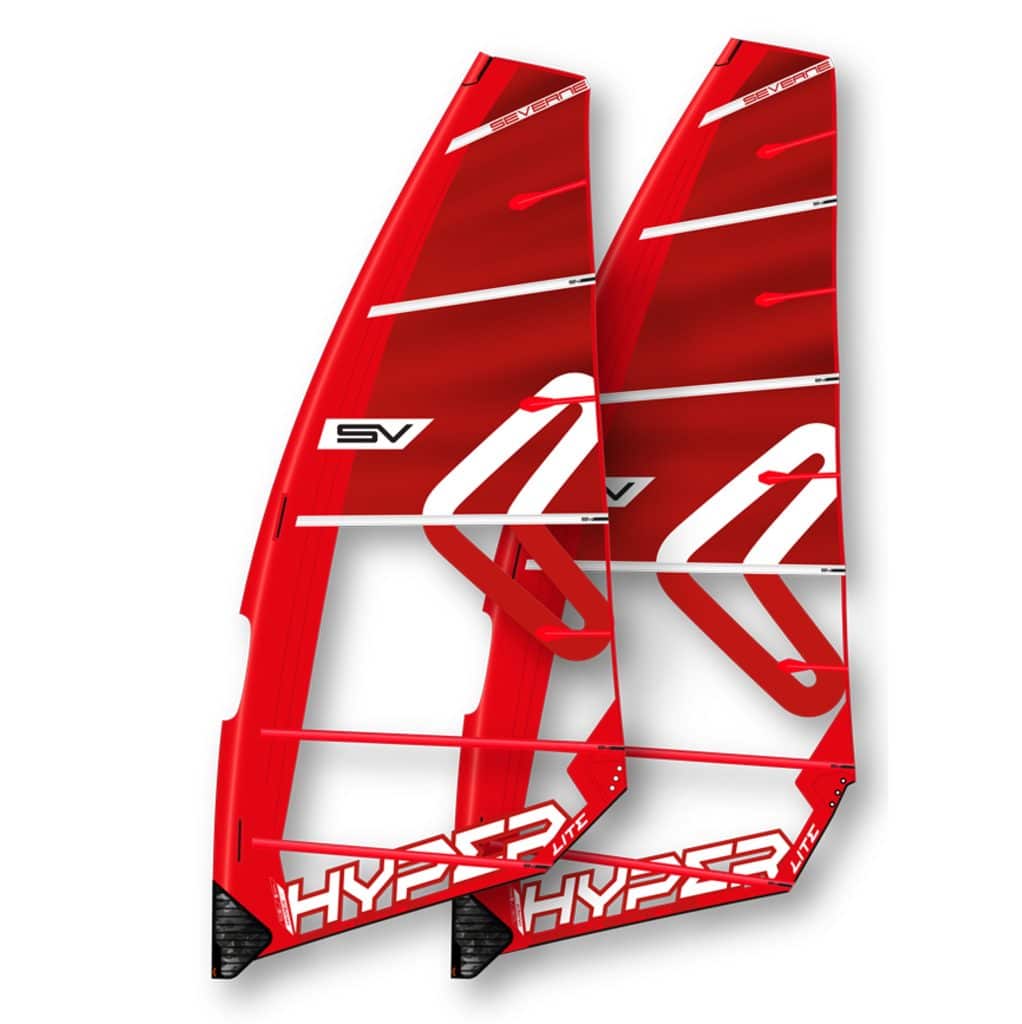
Severne HyperLite
Price range: €809,00 through €929,00 incl. VAT
